Cities across the UK and the world are feeling similar pressures. With growth in population, people living longer and more demand on natural resources. Combined with migration of people into cities (70% by 2050 of all worlds' population) we are indeed moving into challenging times in delivering public services.
The chancellor's autumn statement last year made clear the austerity provisions will still run for possibly another decade. And for a majority of local authorities, this means further cuts in services. The budget for many is now already as low as 40% when compared to 8 years ago. and yet demand on services has never been greater.
The pressures on chief executives and senior management is about the here and now, about next month, the next six months and typically at best up to two years. Within senior management we are in the era of short-term patchwork. It takes a brave leader to take a longer-term view and decide what's best way to set up for the future. How best to provide future services at lower costs at best standard and at local level?
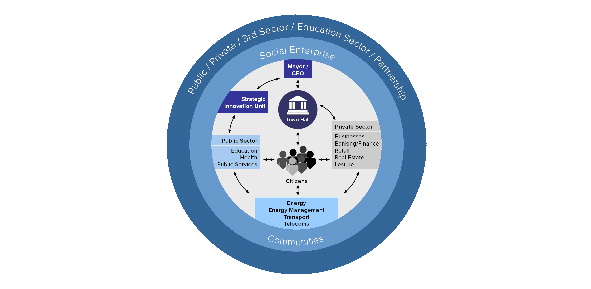
Here at Amnick Social Enterprise (a group of former local authority directors and senior managers) we are developing an alternative strategy to smart cities. While supporting the Governments Department for Business, Energy and Industrial Strategy, we are also improving their proposed new approach by combining this with a social enterprise ethos, shared society and the principals of community involvement.
Using smart cities as a vehicle to deliver the next generation of public services. Our model is completely outcome focussed and seeks to:
- improve quality of life for more
- integrate public/private/third/education sectors
- futureproof
- use technology to support, not lead, us
We are well placed to create this journey building upon our previous national share and support campaign, where we designed and gave to the government our blue print for sharing and working together to create savings and efficiencies. This is now called HMEP and the government has invested £12m into this. http://www.highwaysefficiency.org.uk/
With our partnering universities, we are about to embark on a three year journey exploring the world of smart cities connected with housing, transportation, environment, education etc. We are holding 12 workshops, each of which in itself will be a chapter in a book about integrated best practice to smart cities.
Starting with our first workshop on housing, we are inviting central government politicians, local authority housing departments, housing charities, government policy-makers, as well as homeless people and those living in deprived areas and housing estates.
At this workshop we will be discussing key current housing issues and selecting one or two areas we can all work collaboratively towards. This is in order to design new innovative solutions, that can be worked into a pilot project.
Our difference will be to get users and policy-makers closer together as well as other service delivery organisations and create outcomes that can be developed collaboratively between public/private/third/education sectors with the communities and people who use that service.
Incorporated into these workshops will be innovators and leaders from across the world. International countries will also be interacting via video conferencing from Australia, Italy, Hungary, Poland, USA, India and Singapore. Also special guests will include ex-presidents and mayors from across Europe.
Our design of the next generation of public services will focus on how we can help the third sector and communities fill the gaps of services that local authorities can no longer provide.
The outcomes of our workshops will be a:
Strategic Board for each sector – a mix of people from the relevant industry to act as a sounding board for future smart city projects in their areas of specialism. The aim will be to critique the project with a view to determine greater outcomes.
These include better integration with sustainability, environment, futureroofing and other service areas.
Executive Board – where the chair from each of the above board sits to ensure complete integration across all the public services.
Working Group for each sector – to mix users/ordinary people with specialists, policy-makers, communities, politicians, public authorities and the private sector to come together to design innovative solutions. And then to work together to create business cases to seek funding with a view of setting up pilot projects, seeking funding and making it happen.
The Journey Book – This pulls together the 12 workshops conducted over the three-year period. Each workshop is considered as a chapter, and with 12 chapters we will be delivering an integrated approach to public services – using smart cities and smarter thinking as a vehicle to deliver this.
John David is chief executive of Amnick