
For everyone who has spent the past year preparing for a future that has now shifted, this is a genuinely difficult moment. Councils have been making recruitment decisions around a destination that may no longer arrive or may arrive in a different shape and on a different timeline than anticipated. Vacancies have been held open, permanent appointments delayed, and interim arrangements put in place while organisations prepared for reorganisation. That preparation was real work, done in good faith, often at real personal cost to the people carrying it.
The Government has now withdrawn its decisions for four areas and opened a review of the programme, pausing plans elsewhere. For many, that will feel like months of work and preparation set aside overnight — a significant workforce consequence, on top of the structural one. It's a lot to absorb, and it's reasonable for people to need a moment to process what it means for them before anyone expects a plan.
The review gives Government scope to reconsider the programme around the Prime Minister's devolution ambitions, set out in Rewiring the State. Treating this as a timetable delay may understate the change. The assumptions governing the previous programme are now open to question, including how council reorganisation should fit within a system built around elected mayors and strategic authorities.
That does not mean every existing council will avoid reorganisation. It does mean that recruitment plans built around the previous proposals need to be reconsidered. For councils and candidates alike, the expected destination has changed.
The workforce has already responded to the previous plan
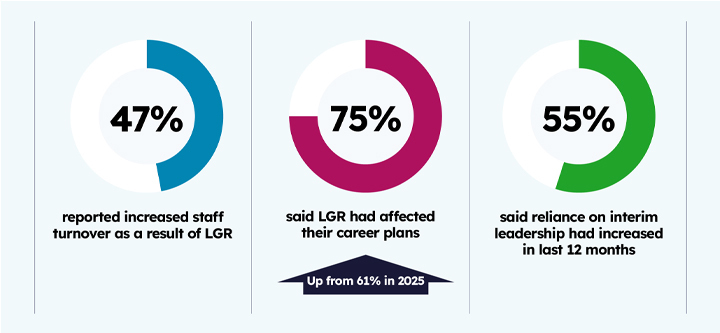
Staying close to how people are actually feeling, and how they're responding, matters as much as tracking the structural changes. Tile Hill surveyed 170 senior officers across unitary, county, and district councils in June and July. Three quarters said LGR had affected their career plans, up from 61% a year earlier. Almost a third had explored or applied for another role in the previous three months, whilst 44% had started informal career conversations outside their organisation.
These findings predate the announcement, and they cannot tell us how officers will respond to the review. What they do show is that career decisions (including some that can't be undone) were already being made under the previous programme. A council cannot recall someone who has already left, and an MTFS built around a vesting day that has now moved needs resetting regardless of what the review decides. Time already diverted to LGR does not return either: 73% of senior leaders who participated in our survey said the time they spent on LGR-related activity had increased over the past 12 months, and 37% described making direct trade-offs between LGR and core service delivery in the past three months. The underlying workload hasn't paused: devolution, social care reform, education reform, housebuilding and planning reform all still need delivering on budgets that still need to balance.
The findings on recruitment are equally important. A quarter of respondents reported delayed permanent recruitment, while 55% said reliance on interim leadership had increased. Almost half (47%) reported increased staff turnover as a result of LGR. Among those experiencing turnover, it's hitting hardest at director level and in specialist, hard-to-fill roles.
The previous programme has already left a workforce legacy. Pausing or withdrawing a structural decision will not bring back someone who has left, or resolve the workload being carried by an acting-up manager. Councils now need to decide which arrangements remain defensible when the programme they were designed to accommodate is being reconsidered. That's not just housekeeping. It's a chance to reset the organisation's burning ambition - to re-establish the vision, re-galvanise teams, and realign resources against short, medium and long-term priorities. Left unaddressed, the risk is measurable. Our research found 41% of senior leaders had already seen an increase in short-term decision-making within their immediate leadership team, and 34% had seen an increase in risk aversion or the deferral of decisions. That is a productivity risk at exactly the moment the sector needs to respond with conviction to a reframed agenda — and only a fifth of senior leaders say they're seeing that commitment reflected in staff behaviour.
Reopen the decisions made because of LGR
The starting point should be a review of appointments delayed, changed, or made temporary specifically because of reorganisation. That review should also make the case for interim on its own terms, as a way to bring in capacity and expertise while a change programme is genuinely still moving. The answer won't always be to make it permanent; sometimes it's the opposite. For each one, councils need to establish whether the original reason still stands.
Some permanent recruitment campaigns that were on hold will now need to begin at pace. Others will still require interim leadership, particularly where the remit is genuinely unsettled or specialist support is needed quickly. The choice should follow the work and the likely duration of the need. Decisions need to be strategic and take into account the varying needs and priorities to ensure resourcing is properly aligned.
An interim brief can also be rewritten. A council that commissioned transition support may now need help restoring management capacity, delivering a savings programme, or rebuilding a service. The appointment should be judged against those outcomes, with a clear review point and a plan for what follows.
People need a fresh conversation
The announcement will land differently with different people. An officer who had been considering leaving because of the prospect of abolition may feel more willing to stay. Someone attracted by a larger role in a new unitary may reassess their options. A leader prepared to remain until a particular transition date may be less willing to commit to an open-ended process.
These are possibilities to investigate through conversations with individuals. The survey gives councils good reason to have them now: 35% of respondents were considering interim or consultancy work, 28% said they were more likely to leave local government, and 18% were considering earlier retirement.
For live recruitment campaigns, that means contacting candidates, checking what has changed for them and revisiting the brief where necessary. Candidates who previously ruled out an authority may now be willing to consider it. Those already in a process may need reassurance about the scope of the job and the council's commitment to making the appointment.
This is where direct headhunting and candid discussion matter. A recruitment pack cannot answer an individual's concerns about joining an organisation whose future has just been reopened. Candidates need to understand the mandate and what they will be expected to deliver. They also need an honest account of what remains unresolved. Promising certainty that a council cannot provide will undermine trust before the appointment begins.
Recruit for the responsibilities taking shape
Rewiring the State is central to this. The July Cabinet statement proposes greater powers and resources for local leaders, stronger strategic authorities, and new career routes between central government and the wider public sector. It includes plans for specialist expertise, leadership development, and secondments to support that shift.
If the LGR review brings council reform into line with that ambition, the recruitment market could look quite different from the one anticipated under the previous programme. Attention has been focused on the leadership posts created by merging councils and the competition for fewer, larger jobs. A stronger mayoral and strategic tier would introduce different opportunities and employers into those career calculations.
For councils, that means thinking about who can represent their place effectively within a more powerful regional system. For strategic authorities, it means securing the expertise to take on devolved functions and deliver investment. Leaders who can negotiate across those institutions, secure agreement, and turn funding into delivery are likely to be sought by both.
Stronger strategic authorities may also create attractive career opportunities for experienced council officers who had been looking towards a new unitary role. Secondments and movement from central government could broaden the available talent pool. Headhunting needs to follow those changing career routes, including where relevant experience can be found beyond the usual shortlist.
A recruitment plan for the council as it stands
At Tile Hill, our advice is to revisit the workforce assumptions made under the previous programme now. Identify the vacancies being carried because of LGR, review flexible resourcing in line with today's requirement, and tomorrow's needs, and speak to the people whose career decisions may have depended on the former timetable.
We can help councils turn this reassessment into a clear recruitment brief. That starts with discussing the appointments previously deferred or shaped by LGR, testing what the organisation now needs, and advising on the balance between permanent recruitment and interim support.
Our relationships with candidates begin well before we are retained to recruit. We stay in regular contact with people across the markets we work in, listening to their ambitions and offering advice as circumstances change. This gives us a close understanding of what this change means for candidates considering their options.
If the announcement has changed your recruitment plans, speak to us about the roles you are reconsidering. You do not need a finished brief to begin that conversation.
For the full survey findings behind this piece — including how senior leaders are approaching retention, resourcing and career planning through reorganisation — download LGR & Devolution: From Anticipation to Opportunity.
Liam Young is a senior consultant in Tile Hill's Executive Search team.

