Outsourcing and contracting can be a positive way of delivering non-core services in a way that creates value, opportunity and more positive experiences. It can also create commercial challenges, time-consuming contract management processes and deliver sub-optimal service outcomes. In almost all circumstances the reasons behind the successes and failures of these processes are nuanced, complex and rely on relationships between stakeholders to dictate their direction.
At its peak, from the 10-15 years or so since 2000-15, the justification and strategic rationale for outsourcing services was – generally – relatively easy to identify: it was to save cash. Specialist organisations who provide these services as their core business were able to generate more efficient staffing and management processes and deploy delivery models where resource could be shared across larger portfolios, managing costs.
However, as contracts enter multiple generations and these efficiencies have already been delivered by previous provider organisations, the reason to procure services from the market needs to be rethought. The ‘strategic case' needs careful consideration.
At council level, the decision to ‘make or buy' will, to some extent, be driven by local politics and these aspirations rightly form part of strategy development. Two things, however, can often be overlooked:
• Beyond achieving savings or simply replacing existing contracts with a new iteration, why procure services from the market – what are we hoping to achieve through this procurement?
• How will we make sure these objectives are delivered?
Each contract, each procurement exercise, should have a clearly define set of objectives, with a clear and measurable set of deliverables that work toward the strategic aim. Yes, commercial outcomes may be embedded in these but they should be more than that to ensure that, as clients, you're leveraging the scale, skill-set and coverage of third party providers.
Successfully managing the relationships of the contracts that are put in place to make sure the objectives are delivered is a disappearing art. There needs to be recognition that client and contractor have objectives to meet from the contract but that the contract itself – and the above deliverables – are what's most important.
Finding capacity to do this within local government is an increasing challenge.
Assure3C
Assure3C is a new structured process for strategically managing service contracts delivered by Cadaema Consulting Services. It is founded on the principles of true partnership through a genuinely independent collaborator, focused solely on the service contract in question.
Assure3C focuses on four key partnership themes – specifically relevant to local government – to provide a transparent ongoing health check of the service contract, making sure it remains on track and delivering on all of the objectives and deliverables.
At Assure3C's heart is its independence. We are equally committed, and empathetic, to all contracting stakeholders to ensure it can represent each organisation fairly within the boundaries of the service contract and further the partnership approach.
Partnership Themes
Assure3C is built on a tiered structure and our experience of managing service contracts within four Partnership Themes:
• Service delivery. At a strategic level, is the contract delivering what it should in terms of the specification but also, is the specification still fit for purpose.
• Commercial. Delivering beneficial outcomes is a key metric for contract success. Understanding and anticipating the commercial needs of all stakeholders through the contract structure is critical to actual and perceived success.
• Added Value. Adding value isn't about delivering what the contract asks for in a different way – it's about creating enhanced outcomes and is a strong indicator of contract success and relationship strength.
• Social Value. Local government exists to serve local communities. All service contracts should actively and proactively support this.
Strategic Partnership Objectives
• Be set for the duration of the contract – ideally set out in the procurement documentation
• Articulate, in high-level terms, what the contract should be achieving for each stakeholder
• Align to one of the four Partnership Themes
• Determine the success of the contract
• Be the link between overarching stakeholder policy to the contract and its deliverables and should only be changed where there is a fundamental change of strategic or legislative direction.
Partnership deliverables
Partnership deliverables are SMART (specific, measurable, achievable, relevant and time-bound) activities that contribute to the Strategic Partnership Objectives. They will:
• Be specific actions
• Have an owner (this could be the client or the contractor)
• Have a delivery timetable that is articulated and understood
• Have clearly-defined quality considerations with approval and sign-off processes
As part of Assure3C, we will work with senior members of each stakeholder organisation to establish the Partnership deliverables each year and to set out the reporting and update processes.
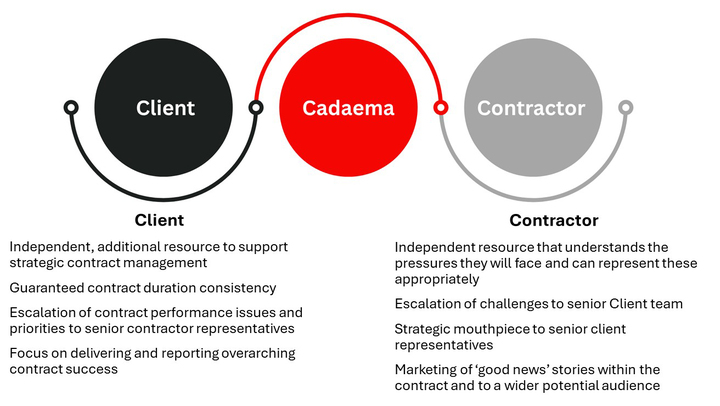
Fundamentally, Assure3C is a strategic brokerage service to support all the success of the service contracts. By putting in place a tri-partite contract with client and contractor, we will be genuinely independent and offer each party insight into the other's objectives and aspirations and work collaboratively to report on contract successes and challenges – creating capacity through strategic oversight.
To find out more about Assure3C visit us at www.cadaema.com